
miércoles, 21 de mayo de 2014
Xylophone origin.
The xylophone (from the Greek words ξύλον—xylon, "wood" + φωνή—phone, "voice", meaning "wooden sound") is a musical instrument in thepercussion family which probably originated independently in Africa and Asia.[1] It consists of wooden bars of various lengths that are struck by plastic, wooden, or rubber mallets. Each bar is tuned to a specific pitch of the musical scale. The term "xylophone" can refer to Western-style concert xylophones or to one of the many wooden mallet percussion instruments found around the world. Xylophones are tuned to different scale systems depending on their origin, including pentatonic, heptatonic, diatonic, orchromatic. The arrangement of the bars is generally from low (longer bars) to high (shorter bars).

Daniel Johnston Biography
Johnston's musical work gained some notoriety when he moved to Austin, Texas. Johnston began to attract the attention of the local press and gained a following augmented in numbers by his habit of handing out tapes to people he met. Live performances were well-attended and hotly anticipated.
His local standing led to him being featured in a 1985 episode of the MTV program The Cutting Edge featuring performers from Austin's "New Sincerity" music scene. Subsequently he performed at the 1985 Woodshock music festival in Austin, where he was featured in a short documentary of the festival, Woodshock.
In 1988, Johnston visited New York City and recorded 1990 with producer Kramer at his Noise New York studio. It was released in 1990 on Kramer's Shimmy-Disc label. This was Johnston's first experience in a professional recording environment after a decade of releasing home-made cassette recordings. His mental health further deteriorated during the making of 1990. In 1989 Johnston released the album It's Spooky in collaboration with Half Japanese singer Jad Fair.
In 1990, Johnston played at a music festival in Austin, Texas. On the way back to West Virginia on a small, private two-seater plane piloted by his father Bill, Johnston had a manic psychotic episode believing he was Casper the Friendly Ghost and removed the key from the plane's ignition and threw it out of the plane. His father, a former Air Force pilot, managed to successfully crash-land the plane, even though "there was nothing down there but trees". Although the plane was destroyed, Johnston and his father emerged with only minor injuries. As a result of this episode, Johnston was involuntarily committed to a mental hospital.
Interest in Johnston increased when Kurt Cobain was frequently photographed wearing a t-shirt featuring the cover image of Johnston's album Hi, How Are You which music journalist Everett True gave him. Kurt Cobain listed Yip/Jump Music as one of his favorite albums in his journal in 1993. In spite of Johnston being resident in a mental hospital at the time, a bidding war to sign him ensued. He refused to sign a multi-album deal with Elektra Records because Metallica was on the label's roster and he was convinced that they were of Satan and would hurt him. He also dropped his manager after having a psychotic episode at a Butthole Surfersconcert. His manager, Kramer, called Johnston's parents after the episode and was in turn fired because he thought: "they'll put me in a looneybin". Ultimately he signed with Atlantic Records in February 1994 and that September released Fun, produced by Paul Leary of Butthole Surfers.] It was a commercial failure. In June 1996, Atlantic dropped Daniel from the label.
Metal music history
Popular music was recorded and marketed as a Counterculture which opposed the normal, functional, and unexciting Culture that was dominant in society; by being outside of that which was in power, Counterculturalists argued, they were able to see what was "real" and to implement a "progressive" worldview in which moral correctness brought us gradually closer to a utopian state.
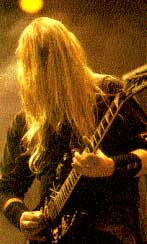 Early metal bands, in emulation of popular music as a whole, hoped to discover what was real by finding out first what was not. This attitude, over the course of four generations of music, took metal beyond the grounds of "good" versus "evil" into nihilism, where nothing had inherent value or classification, but could be described in terms of experience.
This marketing mirrored the process of adolescents, the main audience for popular music, who first reject the world of their parents, then once independent re-assess their own values, and finally, rejoin society on the terms of these recreated values. This determines "reality" as they will act to create it, based upon their values system.
While dominant Culture sought what was pragmatic, and Counterculture pursued the moral, metal music became its own movement because it could not agree with either of those approaches, preferring instead to try to seek what was "real," or meaningful and "heavy" (in the LSD-influenced vernacular of the time). Their approach did not aim at correctness, but assertion of subjective meaning.
Early metal bands, in emulation of popular music as a whole, hoped to discover what was real by finding out first what was not. This attitude, over the course of four generations of music, took metal beyond the grounds of "good" versus "evil" into nihilism, where nothing had inherent value or classification, but could be described in terms of experience.
Nihilism is a frightening belief system for those in societies organized by dualistic (heaven versus earth) and liberal (individualistic, egalitarian) societies, as it denies that our values systems are more real than events in natural reality. To a nihilist, truth is a way we describe some things in reality, but there is no eternal life nor eternal truth which exists separate from immortality. Nihilism means accepting mortality, and experience as what we have in place of a religious or moral truth.
These ideas exceed limits of social acceptability, which in a capitalist liberal democracy threatens the self-marketing which individuals use to gain business partners, social groups and mates. As a result, metal was forced to wholly transcend the artificial consensual reality shared by Culture and Counterculture, and to create its own value system including its nihilism.
Seeking the real, and not the moral, this value system in turn surpassed its own nihilism by moving from a negative logical viewpoint to an assertive one, looking not for something objectively determined to be "eternal" but for that which will be true in any age past or present, discovering through personal experience and acceptance of nihilism (a symbolic analogue for mortality) that which society will not recognize, completing the process of adolescence in a state of actual outsidership.
jueves, 15 de mayo de 2014
The Guitar
A guitar is a popular musical instrument that makes sound by the playing of its (typically) six strings with the sound being projected either acoustically or through electrical amplification (for an acoustic guitar or an electric guitar, respectively). It is typically played by strumming or plucking the strings with the right hand while fretting the strings with the left hand. The guitar is a type of chordophone
 , traditionally constructed from wood and strung with either nylon or steel strings and distinguished from other chordophones by its construction and tuning. The modern guitar was preceded by the lute, the vihuela, the four-course Renaissance guitar, and the five-course baroque guitar, all of which contributed to the development of the modern six-string instrument.
History of pop
Pop is short for popular, and it's remained the defining term for the ever-changing music favoured by the public. Although not specifically applied until the middle of the 20th century, pop music as such can be traced by a few decades before that.
The Early Days
You could say that the songs of music hall were the first real pop songs, written by professionals and widely performed for audiences. That dates back to the Victorian era, when a performer needed a catchy, identifiable song.
Things changed with the advent of recording, early in the 20th century. With that, music had the chance to be much more widely disseminated. Records, played at 78 rpm on wind-up gramophones, were relatively cheap.
In America, that led to a breed of professional songwriters in New York who wrote pieces intended to be recorded and sell well - Tin Pan Alley. They were largely hacks, but did produce some beautiful material. London had its own equivalent as the music business became centred on Denmark Street in the West End.
The Crooners
The first major pop stars as such were the crooners of the 1930s and '40s. Bing Crosby sold millions of records, as did Frank Sinatra (arguably the first modern pop star, with screaming teenage female fans - the bobbysoxers), and in Britain, Al Bowly.
They recorded and performed with full orchestras in the main style of the day. But there were other vocals groups, such as the Mills Brothers and the Inkspots, whose harmonies set the standards for those aspiring to fame.
With the style known as swing, big bands also came into their own, with tunes like Glen Miller's "In The Mood" becoming standards.
The Charts
Curiously, pop music charts as such didn't exist until 1952, when the first Top Twenty was recorded. It came at an interesting time, as "teenagers" really came into being. Historically there'd been no transitional period between childhood and adulthood. Now, after World War II, that seemed to begin, imported from America, and in skiffle, an interpretation of American folk music (personified by Lonnie Donegan), teens found their music.
Rock'n'roll brought much more of that, and Elvis Presley became a global star, the biggest of the late 1950s and early 1960s. But he would find himself supplanted by the Beatles, who revolutionised pop by writing their own material, instigating a fashion that remains undiminished.
The Beatles set the standard for pop music, and it remains undiminished - Beatlesque has become a standard descriptive adjective. From 1962 until their break up in 1970 they dominated the charts in Britain and America.

Biography of Reik
Reik is a Latin Grammy-winning Mexican band from Mexicali, Baja California formed by Jesús Alberto Navarro Rosas (lead vocals), Julio Ramírez Eguía (guitar/background vocals), and Gilberto Marín Espinoza (guitar).
Reik's debut album, 2005’s “Reik” went platinum in Mexico. It featured the singles “Yo Quisiera,” “Qué Vida La Mía,” “Noviembre Sin Ti,” “Niña” and “Levemente.” It reached #13 on the Billboard Latin Pop Albums chat and #34 on the Top Latin Albums chart.
Featuring the singles,”Invierno,” “Me Duele Amarte,” “Sabes” and “De Qué Sirve,” their second album, “Secuencia” was released in 2006. The album reached #12 on the Latin Pop Albums chart and #31 on the Top Latin Albums chart. It was certified gold in Mexico.
Their third album, “Un Dia Mas,” was released in 2008 and won the 2009 Latin Grammy award for Best Pop Album by a Duo/Group with Vocals. It peaked at #11 on the Top Latin Albums chart and was certified platinum. Featured singles included, “Inolvidable” and “Fui.”
“Peligro” followed in 2011 and debuted at #2 on the Latin Pop Albums chart. The lead single and title track, “Peligro,” reached #7 on the Billboard Latin Pop Songs chart.

Reik's debut album, 2005’s “Reik” went platinum in Mexico. It featured the singles “Yo Quisiera,” “Qué Vida La Mía,” “Noviembre Sin Ti,” “Niña” and “Levemente.” It reached #13 on the Billboard Latin Pop Albums chat and #34 on the Top Latin Albums chart.
Featuring the singles,”Invierno,” “Me Duele Amarte,” “Sabes” and “De Qué Sirve,” their second album, “Secuencia” was released in 2006. The album reached #12 on the Latin Pop Albums chart and #31 on the Top Latin Albums chart. It was certified gold in Mexico.
Their third album, “Un Dia Mas,” was released in 2008 and won the 2009 Latin Grammy award for Best Pop Album by a Duo/Group with Vocals. It peaked at #11 on the Top Latin Albums chart and was certified platinum. Featured singles included, “Inolvidable” and “Fui.”
“Peligro” followed in 2011 and debuted at #2 on the Latin Pop Albums chart. The lead single and title track, “Peligro,” reached #7 on the Billboard Latin Pop Songs chart.
viernes, 2 de mayo de 2014
The saxophone
Sax grew up in the trade of instrument making. Sax's father was an expert in instrument making. By the age of six, Sax had already become an expert in it as well. Sax, being the musician he was, became aware of the tonal disparity between strings and winds: moreover, that between brasses and woodwinds. The strings were being overpowered by the winds and the woodwinds were being overblown by the brasses. Sax needed an instrument that would balance the three sections. His answer to the problem was a horn with the body of a brass instrument and the mouthpiece of a woodwind instrument. When he combined these two elements, the saxophone was born.
The first saxophone, a C bass, was displayed for the first time, in 1841, to the famous composer, Hector Berlioz. He was amazed at its versatility, unique tone, and control of dynamics. In 1842, Sax moved to Paris to introduce his new instrument to the rest of the world. Soon to follow was the creation of an entire saxophone family: fourteen different saxophones in all. Each differed by size and pitch. They were the: E flat sopranino, F sopranino, B flat soprano, C soprano, E flat alto, F alto, B flat tenor, C tenor, E flat baritone, B flat bass, C bass, E flat contrabass, and F contrabass. Many of these variations, however, are seldom used or have become obsolete.
The saxophone finally became known as an integral part of all bands in 1845. This is the year of the famous "battle of the bands". The French Army band was still using "traditional" instrumentation. Sax saw this as an opportunity to show the world how the saxophone could improve the tonal quality in all bands. He suggested a contest between an army band composed of the original orchestral instrumentation against a band with an instrumentation that included saxophones. Sax’s band of twenty-eight men, compared to the French Army band of thirty-five, overwhelmed the crowd. That day, the saxophone was officially introduced into the French Army Band and soon to all other bands.

jueves, 1 de mayo de 2014
Alex Campos Biography
 Alex Campos (born September 10, 1976 in Bogota, Colombia) is one of the top Christian singers in all of Latin America. He is the lead singer in his group called Mision Vida. He was nominated in the Christian music soloist or group category of the Premios la Gente (Latin Music and Sports Awards) in 2004.He has five albums. His first was a live CD recorded in Bogota, Colombia named Tiempo de La Cruz (Time of the Cross).His second album was a studio record Al Taller del Maestro (To the Master's Work Shop). He made this album to dedicate it to God because Campos believes God healed his throat tumor.His third album was a live version of Al Taller del Maestro recorded in Bogota, Colombia.His fourth album was a studio record Como un Niño (Like a Child).His fifth album is an unplugged live album recorded in Bogota, Colombia called Acustico, El Sonido del Silencio.His sixth has a new album called Cuidaré de Ti.On July 18, 2007, he and Mision Vida went to Juncos, Puerto Rico to be part of La Mina Music Fest.He participated in Jesus Adrian Romero's new album, Ayer Te Vi... Fue Mas Claro Que La Luna, singing a duo with him, "Razones Pa' Vivir".Alex Campos promotes an organization named Mision Child, for which he plays concerts with the money that is collected in those concerts going to that organization. Alex had a concert in José Miguel Agrelot Coliseum and he became the first Christian singer to sell out all the tickets. There were 12,000 people there. Alex Campos released his seventh album called "Te Puedo Sentir".This Tour has already started a series of concerts that brought him to Denver, Colorado, Elizabeth, New Jersey, McAllen, Texas, Dallas, Texas, and Houston, Texas,. He is currently recording a new cd called "El Lenguage Del Amor"that is being recorded in is own studio called "El Taller" and it is being produced in Bogota, Colombia and Argentina.
Suscribirse a:
Comentarios (Atom)